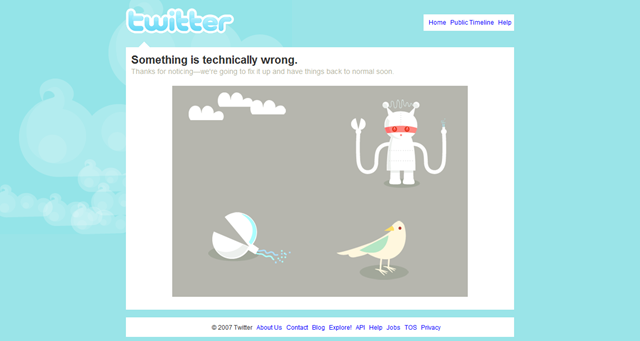
Ok, I’m just keeping a record of when Twitter is down. Like now. The Twitter home page at this time:
This is the kind of thing that everyone is worried about when talking about Twitter. It’s becoming an extremely useful tool, to the point that some people will claim it to be crucial to their daily communications.
Reliability is a key requirement, and I do know from posts on the Twitter Blog and from news that their looking for staff to monitor and maintain solely from the reliability perspective. As an IT consultant & engineer/architect, I can be patient, I can understand the problems that scaling and massive growth can put on a platform. However, many simply see these outages as inability to compensate, or worse, neglect.
Twitter’s engineers and management team will prevail, of that I’m sure, but it’s the timing that I worry about. Even many of it’s most prominent users are becoming more vocal in their concerns about the service. Shel Isreal posted An Open Letter to the Twitter Guys on what Twitter needs to address.
With all the talk of how simply useful Twitter is, the “Twitter Guys” need to take note of how important it has become to hundreds of thousands (millions?) of people world-wide. I believe they know, but suggest as Shel does, that they need to communicate more directly, and with more information on what their doing, especially when they’re having some stability problems. Like today.
As the size of my Twitter Village has grown, the volume of traffic has also had a dramatic increase. There are literally dozens of conversations going on at any one moment. So how does one leverage the strengths of Twitter while being doused with the minutia that makes up a Twitter stream?
Simple. By realizing that you can only participate in relevant conversations. Kind of like walking down a street and hearing random bits of conversations. You don’t always make sense of everything, and most often, you don’t need to. It’s really about being able to join in when you want, or when your wanted. It’s not about “keeping up” at all.
Yes, I tend to skim a bit, maybe one page back at most. All I’m really looking to do is understand what the current conversations are before jumping in. Odds are that my contribution may have already been brought to the conversation and I just like to understand where it’s going before committing some random thought.
Having a larger and larger number of Twitter followers, and following a large number isn’t as hard as I had thought it would be. Moreover, I’m learning a lot more about the community that I’m a part of there. Over the past year, I’ve met a lot of people, and have gotten perspectives that I otherwise would not have had a chance to learn.
Twitter is one of those tools that you really can get value from. It doesn’t replace the blog, or special-interest social networks. Instead it’s an essential tool for the social media explorer’s kit – one that offers much more than it’s simple interface lets on.
What’s your experience as your Twitterverse expands?
Try as I might, there is just nothing of value in Facebook for me. The groups are the only redeeming item on the system, but you have to put up with tons of senseless “apps”. Apps that would’ve been fun back in college when playing quarters or beer bongs, but not when I’m trying to build serious business connections.
While some have made a pretty good case for Facebook, it doesn’t change how it’s viewed by business, or how useful it is for me. I’m astounded at home much time everything takes and how limited everything is. Not to mention the data-ownership question. Just ask Robert Scoble on that one.
I’ve been coming to the conclusion from using many, many different social tools over summer and fall of last year that “social networking” is just an activity. Yep, that’s a “duh” realization, but it’s more than just that. All these “social network” sites are merely a combination of groups on steroids, or worse – simply customizable “home pages” for the masses.
To build real associations with people on a professional and personal level requires interest, dedication, and tools. Facebook could loosely be called a tool, but I think of it as a toy. Tools are designed to do a specific function, and to it well. Twitter is a tool. Blogging is a tool.
I’ve suggested before that my blog is my social network. While that may be incorrect, it is a key tool in my social networking activities. It’s one of three things that are within my control that will never change. My blog address, my email address and my mobile phone number. These are the key pieces of communicating with me that people will never have to re-learn or worry about changing. On these three things, I can build the rest.
The rest is up to me, after all, and how involved in different communities and organizations I want to be. With a blog I can post my views and opinions. With my email address I can interact with just about anyone I share it with, which is everyone, and the same for my cell phone.
I choose to augment this triangle-foundation of my social networking with tools like Twitter, Utterz, IM, LinkedIn, Technorati, del.icio.us, Clipmarks, and several more. I use each for one or two things – the things they do well. None of these are a one-stop-shop for social networking and social media goodness.
Maybe you can point out where I failed with Facebook. I’m always looking to learn – what should I or others be looking for in Facebook? How to approach it? If there really is something there I’m interested in hearing it.
UPDATE: I just wanted to add that I’m leaving the account in place, but will not be active on Facebook. I am interested in what everyone does with Facebook to gain value from it, so don’t hesitate to give my $.02. My Twitter tweets update the “My Status” every time I tweet and I’m notified of Facebook mail if that is the only way you choose to contact me. Cheers!
I really hate to pick on my favorite online service, but… I have to. Twitter started having issues today with all the traffic from “Mac (obsession) World” today. Supposedly over all the mcInterest in what mcRevelations of mystical mcGadgetry Steve mcJobs would reveal for the mcFollowers of the mcCult.
What get’s me curious is how Twitter handled the traffic from CES last week without nary a blip, and out of the blue, McWrld trips it up big time.
Perhaps I’m out of touch and there is more interest from McWrld and that drives higher volumes of traffic. I dunno.
At any rate, Twitter has proven it’s worth to hundreds of thousands of users, but they still have reliability issues when traffic ramps up. I’m on Twitter for the long haul, it’s a core component in my social networking toolkit, so I’m apt to be disappointed when traffic from a marginally relevant tech show drives it’s usability into the ground.
Sometimes it’s hard to find the balance in things. Social media networking is one of these. It takes an enormous amount of effort and time to participate in the social fields, and this can conflict with our primary responsibility of our day jobs. You know, the one we get paid for? 😉
It’s hard, especially when you start to become part of the community. As you get to know the people you’re networking with, and as you have those “aha!” moments that redefine the value of a given social networking tool, it becomes more important to participate. But what of work? How do you stay connected with your online friends when you have limited or monitored access?
Or forget about access to your online social resources, how about the workload that you have? What about priorities? These may sound like ridiculous questions to some, but for those trying to forge a new career and life goals from social media, it is paramount.
I have no profound wisdom, and fewer hard-won examples to go with this question. I’ve only a few ideas that I’m working on in order to find my own way through this difficult portion of social media. Here are some of the ideas, tools, and techniques I’m trying, in order to help me GTD and still network.
“Twitter Scope: down” Many fellow Twitters will recognize that one. Simply logging off the social tools we use is the best start. Schedule a time during the day to log in and check/update status.
Reduce the number of sites/tools Another tip would be to reduce the number of social networking or social media sites that you visit or try to keep up with.
Groom that RSS reader Seriously pare down the number of feeds you read. How many tech feeds do you have? How many times do you see the same post in each? ‘Nuf said. Find the bloggers and sites that simply adhere to your ideas, themes, beliefs, etc… and follow those. News is everywhere and easy to find. Intelligent posts that are relevant to you are not. For those Google Reader users out there, check out the Trends feature and use it to identify abandoned or otherwise seldom-updated feeds.
GTD Find the organization tool that works for you. For many it’s the Seven Habits, or GTD that work wonders. For others, it’s a simple Moleskine, notebook, or other simple list. Maybe leadership training, or project management skills help drill in the needed organization lessons. Whatever it is, give it a try and stick with what works.
Schedule Social Time Here is another simple but effective technique. Just like having a girls or boys night out – schedule your social networking time to fit your day. Breaks, lunch, before/after work. All these are simple to do, and your social network will adapt to your participation.
Integrate If your employer or job permits, maybe you simply integrate your social networking with your job. Got your favorite email & IM client open all day? Why not have a good Twitter Client open all day as well? Leave yourself logged into Facebook for all the special interest groups. Use some time during the day and answer questions on LinkedIn. Keep it business focused, not “Saturday night” focused.
Obviously number 6 is for folks who work in an industry that has direct tie-ins to social networking or media in some way. There may also be some environments that simply don’t care what you do as long as you get the tasks you are responsible for done as expected. Kudos to those who do.
Now, I really want to learn more, because I’ve only mentioned the really obvious ones. What tips do you have? What other techniques and tools are there to help manage being an active social participant and not getting in trouble?
@MAC_Arms Pay taxes when you make your money, pay taxes when you spend your money, pay taxes when you successfully invest your money, pay taxes when you save enough taxed money to afford a house, pay taxes to live in your house, pay taxes when you sell the house that you paid taxes on to
Yup, taxes are criminal and we need serious reforms. I've always said that if you want to see a tax revolt, make withholdings illegal and have Americans write a tax check every payday. They'll revolt for sure. You don't miss what you never had.
Sen. @berniemoreno says voter ID and proof of citizenship are simply common sense.
“We’re talking about a very low threshold — identify who you are and prove you’re a U.S. citizen when you register to vote. I think we’re getting closer to