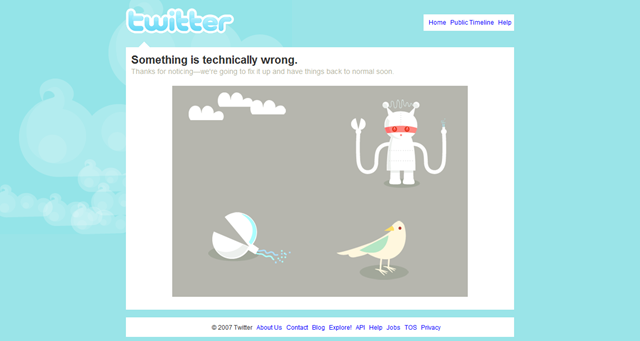
Earlier today when Twitter went offline, I was only marginally annoyed. Mainly because I had a lot of work to get done. I’m quite surprised tonight when I pop on to check out what’s been happening for the last several hours.
Hmm, now I’m frustrated. First time I’ve felt that way towards Twitter. Not sure I really like that either.
Ok, I’m just keeping a record of when Twitter is down. Like now. The Twitter home page at this time:
This is the kind of thing that everyone is worried about when talking about Twitter. It’s becoming an extremely useful tool, to the point that some people will claim it to be crucial to their daily communications.
Reliability is a key requirement, and I do know from posts on the Twitter Blog and from news that their looking for staff to monitor and maintain solely from the reliability perspective. As an IT consultant & engineer/architect, I can be patient, I can understand the problems that scaling and massive growth can put on a platform. However, many simply see these outages as inability to compensate, or worse, neglect.
Twitter’s engineers and management team will prevail, of that I’m sure, but it’s the timing that I worry about. Even many of it’s most prominent users are becoming more vocal in their concerns about the service. Shel Isreal posted An Open Letter to the Twitter Guys on what Twitter needs to address.
With all the talk of how simply useful Twitter is, the “Twitter Guys” need to take note of how important it has become to hundreds of thousands (millions?) of people world-wide. I believe they know, but suggest as Shel does, that they need to communicate more directly, and with more information on what their doing, especially when they’re having some stability problems. Like today.
As the size of my Twitter Village has grown, the volume of traffic has also had a dramatic increase. There are literally dozens of conversations going on at any one moment. So how does one leverage the strengths of Twitter while being doused with the minutia that makes up a Twitter stream?
Simple. By realizing that you can only participate in relevant conversations. Kind of like walking down a street and hearing random bits of conversations. You don’t always make sense of everything, and most often, you don’t need to. It’s really about being able to join in when you want, or when your wanted. It’s not about “keeping up” at all.
Yes, I tend to skim a bit, maybe one page back at most. All I’m really looking to do is understand what the current conversations are before jumping in. Odds are that my contribution may have already been brought to the conversation and I just like to understand where it’s going before committing some random thought.
Having a larger and larger number of Twitter followers, and following a large number isn’t as hard as I had thought it would be. Moreover, I’m learning a lot more about the community that I’m a part of there. Over the past year, I’ve met a lot of people, and have gotten perspectives that I otherwise would not have had a chance to learn.
Twitter is one of those tools that you really can get value from. It doesn’t replace the blog, or special-interest social networks. Instead it’s an essential tool for the social media explorer’s kit – one that offers much more than it’s simple interface lets on.
What’s your experience as your Twitterverse expands?
Try as I might, there is just nothing of value in Facebook for me. The groups are the only redeeming item on the system, but you have to put up with tons of senseless “apps”. Apps that would’ve been fun back in college when playing quarters or beer bongs, but not when I’m trying to build serious business connections.
While some have made a pretty good case for Facebook, it doesn’t change how it’s viewed by business, or how useful it is for me. I’m astounded at home much time everything takes and how limited everything is. Not to mention the data-ownership question. Just ask Robert Scoble on that one.
I’ve been coming to the conclusion from using many, many different social tools over summer and fall of last year that “social networking” is just an activity. Yep, that’s a “duh” realization, but it’s more than just that. All these “social network” sites are merely a combination of groups on steroids, or worse – simply customizable “home pages” for the masses.
To build real associations with people on a professional and personal level requires interest, dedication, and tools. Facebook could loosely be called a tool, but I think of it as a toy. Tools are designed to do a specific function, and to it well. Twitter is a tool. Blogging is a tool.
I’ve suggested before that my blog is my social network. While that may be incorrect, it is a key tool in my social networking activities. It’s one of three things that are within my control that will never change. My blog address, my email address and my mobile phone number. These are the key pieces of communicating with me that people will never have to re-learn or worry about changing. On these three things, I can build the rest.
The rest is up to me, after all, and how involved in different communities and organizations I want to be. With a blog I can post my views and opinions. With my email address I can interact with just about anyone I share it with, which is everyone, and the same for my cell phone.
I choose to augment this triangle-foundation of my social networking with tools like Twitter, Utterz, IM, LinkedIn, Technorati, del.icio.us, Clipmarks, and several more. I use each for one or two things – the things they do well. None of these are a one-stop-shop for social networking and social media goodness.
Maybe you can point out where I failed with Facebook. I’m always looking to learn – what should I or others be looking for in Facebook? How to approach it? If there really is something there I’m interested in hearing it.
UPDATE: I just wanted to add that I’m leaving the account in place, but will not be active on Facebook. I am interested in what everyone does with Facebook to gain value from it, so don’t hesitate to give my $.02. My Twitter tweets update the “My Status” every time I tweet and I’m notified of Facebook mail if that is the only way you choose to contact me. Cheers!
Hey there, ho there – with the current mini-meme of online office app’s getting a bit more attention, I thought I’d give ’em another go. That is, I have used all the major ones in the past year and a half, but have mostly come back to Microsoft Office.
Of course, I truly need MS Office Pro – my clients need documents in Word, drawings in Visio, sheets in Excel, projects in Project, you get the point. So I can’t get rid of Office anytime soon.
However, I can move my needs to the web. This is nothing new as I’ve done thisbefore, and will continue to look at both online & offline solutions for the tasks at hand. What’s interesting is that, most of my existing data is already online. Either in Zoho or Google Docs, I’ve already migrated my “old” data to either one of these services.
Now, some of these posts today talk about the numbers of users, and how these must be an example of the lack of interest by the user community. While it may be true in many instances, my belief is that the applications are just now becoming really comparable to desktop-based solutions. I do think that there is a big future for online app’s, and as more tools like Adobe AIR and Microsoft Silverlight are incorporated, there is very little limit to the things that can be done as a service.
The pieces are already in place, I’m switching back to online app’s instead of Office for my personal use. With the advent of things like Zoho Notebook – even my need of Microsoft OneNote can be addressed.
How about you? Do you use online app’s on a regular basis, just dabble, or avoid these like the plague?
Other people talking about online office app’s & suites today:
@MAC_Arms Pay taxes when you make your money, pay taxes when you spend your money, pay taxes when you successfully invest your money, pay taxes when you save enough taxed money to afford a house, pay taxes to live in your house, pay taxes when you sell the house that you paid taxes on to
Yup, taxes are criminal and we need serious reforms. I've always said that if you want to see a tax revolt, make withholdings illegal and have Americans write a tax check every payday. They'll revolt for sure. You don't miss what you never had.
Sen. @berniemoreno says voter ID and proof of citizenship are simply common sense.
“We’re talking about a very low threshold — identify who you are and prove you’re a U.S. citizen when you register to vote. I think we’re getting closer to