


Blog
Thoughts and things I care to shareContract, one part of the consulting gig
One of the problems of contract work as opposed to consulting is the length of time that a person spends at one assignment. Sure, it’s nice to have a steady, billable gig for a time, but it brings its own unique challenges. One of these challenges is that team members in the organization, even management, seem to forget that you’re just a temporary troubleshooter.
The implications from this are that they start building plans or structure around you and not the role you’re filling. Many folks simply forget that you’re here to fulfill a specific need, run a single project, or fix a unique system that is outside the scope or abilities of the existing staff. It’s bothersome when people start talking as if you’ll be there “next year” or when managers start implying that they need to make sure to “keep you around”.
Like many, I’m flattered by those sentiments and sometimes think it may not be too bad to go back to the corporate gig with a desk & phone and a guaranteed payday every week. However, there are too many aspects of the independent consultant that are appealing to really let that happen.
While the risk of uncertain pay schedules is the biggest issue, the benefits of bringing your workspace with you every day are too many to ignore. You are your own boss. You ultimately control your schedule. You determine your pay rate. You are responsible for your personal evaluation. You decide how the profits are spent.
The net result of being an independent consultant is that you gain control over these things – even in a longer contract, these items are still under your purview. Giving up that control and “working for the man” is the part for many consultants that is simply unacceptable. The feeling that long-term contracts adds is a mix of the consulting/employee feeling, even though you have control, the longer you are sitting somewhere, the longer people think you belong there – or to them in some way.
That’s one of the aspects of contract work that bothers me – the expectation in many areas by the team members you work with that you either should be hired on, or ultimately will be. Only for them to be disappointed when it doesn’t happen. For me, I’m content to simply be a great consultant that helps clients achieve their goals.
Contract, one part of the consulting gig
One of the problems of contract work as opposed to consulting is the length of time that a person spends at one assignment. Sure, it’s nice to have a steady, billable gig for a time, but it brings its own unique challenges. One of these challenges is that team members in the organization, even management, seem to forget that you’re just a temporary troubleshooter.
The implications from this are that they start building plans or structure around you and not the role you’re filling. Many folks simply forget that you’re here to fulfill a specific need, run a single project, or fix a unique system that is outside the scope or abilities of the existing staff. It’s bothersome when people start talking as if you’ll be there “next year” or when managers start implying that they need to make sure to “keep you around”.
Like many, I’m flattered by those sentiments and sometimes think it may not be too bad to go back to the corporate gig with a desk & phone and a guaranteed payday every week. However, there are too many aspects of the independent consultant that are appealing to really let that happen.
While the risk of uncertain pay schedules is the biggest issue, the benefits of bringing your workspace with you every day are too many to ignore. You are your own boss. You ultimately control your schedule. You determine your pay rate. You are responsible for your personal evaluation. You decide how the profits are spent.
The net result of being an independent consultant is that you gain control over these things – even in a longer contract, these items are still under your purview. Giving up that control and “working for the man” is the part for many consultants that is simply unacceptable. The feeling that long-term contracts adds is a mix of the consulting/employee feeling, even though you have control, the longer you are sitting somewhere, the longer people think you belong there – or to them in some way.
That’s one of the aspects of contract work that bothers me – the expectation in many areas by the team members you work with that you either should be hired on, or ultimately will be. Only for them to be disappointed when it doesn’t happen. For me, I’m content to simply be a great consultant that helps clients achieve their goals.
Personal Branding Magazine – August 2008 Issue
 I’d like to bring your attention to the upcoming August 2008 issue of Personal Branding Magazine. Starting it’s second year of publication, PBM is kicking off Volume 2 with a bang. This months focus is on Millennials, and how they’re changing the way we do business.
For those who have not yet subscribed, PBM is offering a free sample issue that is an excellent example of the information you’ll find in each quarterly issue. Publisher Dan Schawbel also has an introduction video that you may want to view regarding this issue and some fun news.
PBM is also launching a new Facebook Fan Page & Group for anyone interested in more branding and networking opportunities with your fellow PBM subscribers.
Congratulations to the staff, columnists, writers, and publisher of PBM on a great issue to kick off Volume 2!
X
I want to believe.
Social Web: Blogging Constant Change
I’ve been reading a lot of bloggers and fellow social media travelers lately and they’ve all had a common thread. That commonality in opinion is that there is a shift in blogging vs. social networks, and I have to agree that there is.
It appears to me that a lot of the interactivity that used to occur on blogs is moving to the major social tools (pick your favorite). As usual, there is a blogging meme to go along with that, something like blogging being ‘dead’. While I can’t speak to the realities of that & it does seem to me that many of us are spending a lot of the time we used to spend on blogging, now on the social web.
Instead of posting opinions or taking hours crafting a great informative post, we immediately share what we’re currently doing and where we’re doing it. We can do it on the fly with most phones, and since status updates are a mere sentence or so & it’s nothing to whip off a few of these messages and move on.
Does this have a negative consequence for blogging? I think not, but I’ll admit to being biased. Even so, anyone can point to my own blog and see that I’ve been lax in posting in the last couple months. Sure, it is due (in part) to the social web and all the easy-to-use tools. Sure, there are a number of known bloggers either hanging it up, or going on hiatus. However, I think that there are many times when people simply need to do something else in order to rediscover themselves. I remember Robert Scoble doing this about two years ago for a few months. Russell Beattie took a long break before coming back to the blogging sphere as well.
Neither of these guys had preconceived ideas of how long or why, but just knew they needed the change. It’s something I’ve thought about myself when I’m struggling.
I guess the point is that blogging is dead, but the realities of the social web are the same in every part of life: change is constant.
GoDaddy: isn’t your goto-daddy today!
Arg!
There, I’ve gotten that off my chest. Usually I jump on my blog early in the day and check up on a few things. You know, like comments, spam, outdated plugins, incoming links, etc… Then come back later in the day and, hopefully, get a post written and posted a couple times a week. Of course, I’ve been quite lax in that area lately. 😉
So this evening, I go to log into my blog and I get this:
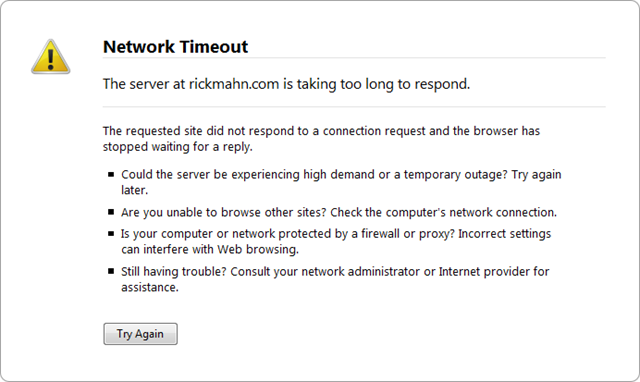
I dig a little deeper and find that the entire godaddy.com site, services, and everyone who hosts their sites with them is offline. Heck, even TechCrunch was unreachable for me – are they on GoDaddy too?
Apparently GoDaddy is the exclusive registrar for the new .me TLD domains, and many in the blogosphere are pointing to the massive registration and failure of correct billing of these new domains. I can’t find enough time at this point this evening to really give a good account of what’s really going on. All I’m reading is people’s experiences and their frustrations, so I’ll hold off on drawing any conclusions.
At this point, about 9:00PM (CT), I’m not really upset yet. Sure, my blog is down – all my sites are down actually – but I really don’t know the facts, and I can’t blame people for things without knowing the whole story. As an IT pro – I’m continuously amazed that all this stuff works in the first place, so I’m not too surprised when a complex operation or an overabundance of traffic takes a site or service down. Don’t tell anyone, but it’s figuring out the reasons that these things happen is the puzzles that I really love to solve most. 😉
So I’m writing this post offline and will upload later when GoDaddy is back – hope it’s tonight. My comment to the team at GoDaddy right now: don’t rush, you’ve got a big outage – take the time you need to be able to come back at or near 100%. Good luck!
UPDATE: Just as I finished this post, up came GoDaddy.
UPDATE 2: I got a friendly call on Friday (July 18th) from GoDaddy’s “office of the President” from a fellow named Alon. Nice guy, he explained the challenges that GoDaddy (and other registrars) faced when new TLDs were brought online with the large number of highly sought after domains.
We also talked about the outage that I (and many others) suffered through when we couldn’t access our hosted sites. It seems that the problem was actually with Comcast and their network. Appearantly (and I have yet to verify this, but have heard rumblings about it) Comcast had a trunk issue in their network that affected customers in the midwest that affected their ability to access many sites that appear to be hosted in the Pheonix area. Strange stuff, but it happens.
So I was right, I didn’t have the whole story – still don’t, but at least it’s starting to make a bit of sense. Also, I see that this post is attracting a bit of attention for comment spammers. Just an FYI to those types of folks: I’m deleting any spam post, so move on.
As the IT world turns
The more time I spend working in the Information Technology field, the more I see opportunities. Usually, it’s simply a an old technology being consumed by a newer one – like traditional telephones being taken over by VoIP phones on the corporate desktop. I’ve championed that notion for nearly a decade, and only now is that really happening at an increasing pace. Cool stuff if you get a chance to use it too.
However, that’s not what I see happening right now. It’s much simpler and much more fundamental than another Microsoft Windows server taking on another role from another team or technology. The changes that are afoot are at the root, the foundation of enterprise computing and it has a social media tie-in. I have a message for my peers in the Information Technologies field. Your world is already changing, and if you don’t see what’s happening, you’ll be left behind.
The change that’s taking place renders the corporate desktop as we know it, obsolete. The disparate servers, inefficient. This is something that I’ve been watching for some time, but only recently have seen some indications that convince me that the world has turned the corner.
What are these things that change the entire game? Why, virtualization, thin clients and “web 2.0” software of course. You already are talking about these things. You are probably working with a couple of them if not a combination of all in some way. What’s convinced me that IT ten years from now will be a wildly different landscape than it is today is the fact that virtualization works, thin clients are actually viable now, and “web 2.0” software is past the “wow” stage and into solving business needs. Add the idea that many software solutions don’t care if they run on Windows/Unix/Linux and you now have a broad base of reliable, sustainable open source systems to choose from.
There is also the introduction of Gen Y into the workforce, who bring a different expectation to work. By being more mobile, working remotely via the web, and having social media & networking as second nature, this workforce alone will bring an impressive amount of change.
So what is the bottom line I’m saying for corporate IT? I’m saying that the desktop as we know it is dead. Windows “7” may be the last “legacy” operating system to be deployed. Desktops will disappear completely as well as individual servers. Servers in general will all be virtual machines run from high availability clusters (OS does not matter) in remote data centers. If you don’t have room for one, it’ll probably be cost-effective to simply lease them from companies like Amazon and such.
While Microsoft Office will still be the “gold standard” that we compare things to, it will become irrelevant in the coming years as open source and online versions of this type of software bring more options faster, and simply chip away at the venerable office suite.
Windows itself will still remain – remaining a popular option for the consumer computing device, all of which will end up being the laptop format. Windows, along with OS X and a couple popular Linux distributions will continue to drive these machines, merging more business and entertainment functions together.
The coming change is huge, and with it the opportunities as well. Like the change that started 20 years ago where mainframe and minicomputers were starting to be replaced with microcomputers, our current definitions of enterprise computing will change radically in the next few years. Are you ready? Will you be a part of it? What else do you see?
testing twitter tools1
Just testing Twitter Tools…
Social Media Breakfast – Twin Cities 5
 Join us to network and chat about using social media and social networking tools in your business and careers.
Our fifth gathering will be at the beautiful Minneapolis Central Library in the Doty Board Room. They’ll be plenty of room, Wi-Fi, and lots of coffee and pastries (thanks to our generous sponsors!). What a perfect opportunity to show off your new 3G iPod!
Agenda:
- Special guest speaker: Jon Gordon (@jongordon onTwitter, Public Radio Tech Reporter and host of “Future Tense“)
- Special guest speaker: Paul Saarinen (@taulpaul on Twitter – talking about “How online gaming taught me everything about social mediaâ€)
- Presentation on how Hennepin County Library uses social media by Meg Canada and Jody Wurl (@MegCanada & @Jodyth on Twitter)
- Review of PublicRadioCamp
- SMBMSP logo reviewOpen discussion (Anything left over from last time, or things you want to see addressed, or things you had heard in conversations on Twitter, Plurk, Friendfeed, Identi.ca etc.)
Visit & join our own social networking site: http://smbmsp.ning.com
RSVP Here: http://upcoming.yahoo.com/event/872412/?ps=7
Maps, Buses, Rail, Bikes, Parking, Directions: http://www.mpls.lib.mn.us/centralmap.asp
See you there!
A special thank-you to @myklroventine and @megcanada for their work on putting this event together!
Happy Birthday Jon
 I wanted to write a different post wishing Jon a happy 50th birthday, but he didn’t want that. Instead, Jon suggested 8 ways to celebrate his birthday. You see, Jon has a way of finding the truth of things and sharing them. He’s brought many of the best ideas forward on his blog, and in person, in a way to make a person think of them in new ways. I always like that.
Jon, you asked for us to try and do one of those 8 things, and I’m glad to say I do two of them every day (makes me think I’m doing better at being the person I want to be than I thought)! So I see a couple more that I can do today, and will do so in honor of your birthday.
So, Happy Birthday Jon – and thank you for giving us ideas on how to give back.
🙂
Photo Credit: Jon Swanson (of course!)


@MAC_Arms Pay taxes when you make your money, pay taxes when you spend your money, pay taxes when you successfully invest your money, pay taxes when you save enough taxed money to afford a house, pay taxes to live in your house, pay taxes when you sell the house that you paid taxes on to

Yup, taxes are criminal and we need serious reforms. I've always said that if you want to see a tax revolt, make withholdings illegal and have Americans write a tax check every payday. They'll revolt for sure. You don't miss what you never had.

I think it’s safe to say that @GovEvers should stop blocking audits in Wisconsin and open the books…

“Only AMERICAN citizens should vote.”
Sen. @berniemoreno says voter ID and proof of citizenship are simply common sense.
“We’re talking about a very low threshold — identify who you are and prove you’re a U.S. citizen when you register to vote. I think we’re getting closer to

Wrong. Democrats are solely responsible for hours-long airport lines.
They voted to defund TSA three times and won’t even entertain a conversation about reopening it. Why?
They’re using it as leverage to stop enforcing immigration laws.