

Happiness CCXXVIII
Another weekend, another payday well spent.

Another weekend, another payday well spent.
Arg!
There, I’ve gotten that off my chest. Usually I jump on my blog early in the day and check up on a few things. You know, like comments, spam, outdated plugins, incoming links, etc… Then come back later in the day and, hopefully, get a post written and posted a couple times a week. Of course, I’ve been quite lax in that area lately. 😉
So this evening, I go to log into my blog and I get this:
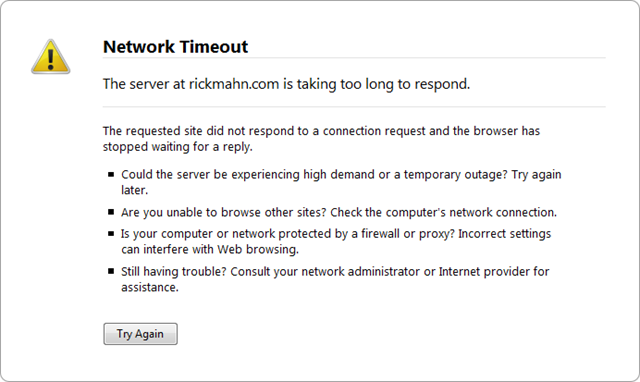
I dig a little deeper and find that the entire godaddy.com site, services, and everyone who hosts their sites with them is offline. Heck, even TechCrunch was unreachable for me – are they on GoDaddy too?
Apparently GoDaddy is the exclusive registrar for the new .me TLD domains, and many in the blogosphere are pointing to the massive registration and failure of correct billing of these new domains. I can’t find enough time at this point this evening to really give a good account of what’s really going on. All I’m reading is people’s experiences and their frustrations, so I’ll hold off on drawing any conclusions.
At this point, about 9:00PM (CT), I’m not really upset yet. Sure, my blog is down – all my sites are down actually – but I really don’t know the facts, and I can’t blame people for things without knowing the whole story. As an IT pro – I’m continuously amazed that all this stuff works in the first place, so I’m not too surprised when a complex operation or an overabundance of traffic takes a site or service down. Don’t tell anyone, but it’s figuring out the reasons that these things happen is the puzzles that I really love to solve most. 😉
So I’m writing this post offline and will upload later when GoDaddy is back – hope it’s tonight. My comment to the team at GoDaddy right now: don’t rush, you’ve got a big outage – take the time you need to be able to come back at or near 100%. Good luck!
UPDATE: Just as I finished this post, up came GoDaddy.
UPDATE 2: I got a friendly call on Friday (July 18th) from GoDaddy’s “office of the President” from a fellow named Alon. Nice guy, he explained the challenges that GoDaddy (and other registrars) faced when new TLDs were brought online with the large number of highly sought after domains.
We also talked about the outage that I (and many others) suffered through when we couldn’t access our hosted sites. It seems that the problem was actually with Comcast and their network. Appearantly (and I have yet to verify this, but have heard rumblings about it) Comcast had a trunk issue in their network that affected customers in the midwest that affected their ability to access many sites that appear to be hosted in the Pheonix area. Strange stuff, but it happens.
So I was right, I didn’t have the whole story – still don’t, but at least it’s starting to make a bit of sense. Also, I see that this post is attracting a bit of attention for comment spammers. Just an FYI to those types of folks: I’m deleting any spam post, so move on.
Getting something that I didn’t think I could and realizing it was the right thing to do.
The more time I spend working in the Information Technology field, the more I see opportunities. Usually, it’s simply a an old technology being consumed by a newer one – like traditional telephones being taken over by VoIP phones on the corporate desktop. I’ve championed that notion for nearly a decade, and only now is that really happening at an increasing pace. Cool stuff if you get a chance to use it too.
However, that’s not what I see happening right now. It’s much simpler and much more fundamental than another Microsoft Windows server taking on another role from another team or technology. The changes that are afoot are at the root, the foundation of enterprise computing and it has a social media tie-in. I have a message for my peers in the Information Technologies field. Your world is already changing, and if you don’t see what’s happening, you’ll be left behind.
The change that’s taking place renders the corporate desktop as we know it, obsolete. The disparate servers, inefficient. This is something that I’ve been watching for some time, but only recently have seen some indications that convince me that the world has turned the corner.
What are these things that change the entire game? Why, virtualization, thin clients and “web 2.0” software of course. You already are talking about these things. You are probably working with a couple of them if not a combination of all in some way. What’s convinced me that IT ten years from now will be a wildly different landscape than it is today is the fact that virtualization works, thin clients are actually viable now, and “web 2.0” software is past the “wow” stage and into solving business needs. Add the idea that many software solutions don’t care if they run on Windows/Unix/Linux and you now have a broad base of reliable, sustainable open source systems to choose from.
There is also the introduction of Gen Y into the workforce, who bring a different expectation to work. By being more mobile, working remotely via the web, and having social media & networking as second nature, this workforce alone will bring an impressive amount of change.
So what is the bottom line I’m saying for corporate IT? I’m saying that the desktop as we know it is dead. Windows “7” may be the last “legacy” operating system to be deployed. Desktops will disappear completely as well as individual servers. Servers in general will all be virtual machines run from high availability clusters (OS does not matter) in remote data centers. If you don’t have room for one, it’ll probably be cost-effective to simply lease them from companies like Amazon and such.
While Microsoft Office will still be the “gold standard” that we compare things to, it will become irrelevant in the coming years as open source and online versions of this type of software bring more options faster, and simply chip away at the venerable office suite.
Windows itself will still remain – remaining a popular option for the consumer computing device, all of which will end up being the laptop format. Windows, along with OS X and a couple popular Linux distributions will continue to drive these machines, merging more business and entertainment functions together.
The coming change is huge, and with it the opportunities as well. Like the change that started 20 years ago where mainframe and minicomputers were starting to be replaced with microcomputers, our current definitions of enterprise computing will change radically in the next few years. Are you ready? Will you be a part of it? What else do you see?
Thankful for the opportunities that I’ve been given.
There’s NO valid argument against the SAVE America Act.
My bill would make it easy to vote.
And hard to cheat.
As soon as DHS is fully funded (as it should be within 48 hours), the Senate should resume consideration of it—and stay on the bill until it passes.
Pass it on.
How are Democrats cheating in L.A.?
Let me show you…
There are 26 registered voters at this toilet in Los Angeles.
I’m not kidding. I have the voter records. See for yourself. The only thing here is a stinky port-a john inside an empty parking lot.
No homes. No mailboxes.
As governor, the State Capitol will stand for unity and common sense.
In addition to the POW/MIA flag that has long flown over the State Capitol, we will fly two flags when I am governor: the Wisconsin state flag and the American flag.
That’s it. No politics.


